
How to Build a Real Estate Business Plan for Investors [7 Steps]

A real estate business plan for investors serves as a strategic roadmap for building, managing, and scaling an investment portfolio. Investors who document their goals, funding approach, and acquisition strategy gain a clear direction and stronger credibility when seeking capital or partnerships. Rather than relying on guesswork, a structured plan outlines how properties will be sourced, financed, managed, and eventually exited.
This guide breaks down how to create a plan that supports long-term profitability, whether the objective is rental income, property flips, or portfolio expansion. Investors can apply these steps to establish financial targets, evaluate markets, and present a professional strategy to lenders, private investors, or joint venture partners.
What Is a Real Estate Business Plan for Investors & Why It Matters
A real estate business plan for investors is a formal document that outlines an investor’s goals, target markets, acquisition strategies, financial projections, and operational structure. It functions as a blueprint that guides decision-making and supports accountability throughout each investment stage.
Unlike a general business concept, an investor-focused plan includes property criteria, expected returns, risk analysis, and exit strategies. It is built to satisfy both personal direction and external scrutiny from financial partners.
Key Purposes of a Real Estate Investor Business Plan
- Strategic clarity: Defines investment goals, timelines, and performance metrics.
- Financial discipline: Outlines capital requirements, funding structures, and projected cash flow.
- Credibility with lenders: Demonstrates preparedness when approaching banks, hard money lenders, or equity partners.
- Risk mitigation: Prepares contingency plans for market shifts, vacancies, or renovation overruns.
A well-structured plan is especially valuable when building a portfolio that depends on leverage. Lenders and private investors often require detailed projections, asset strategies, and market analysis before committing capital. Even solo investors benefit from documenting criteria to avoid impulsive property decisions.
A professional business plan delivers long-term structure, helping investors measure performance, track returns, and make informed adjustments as market conditions change.
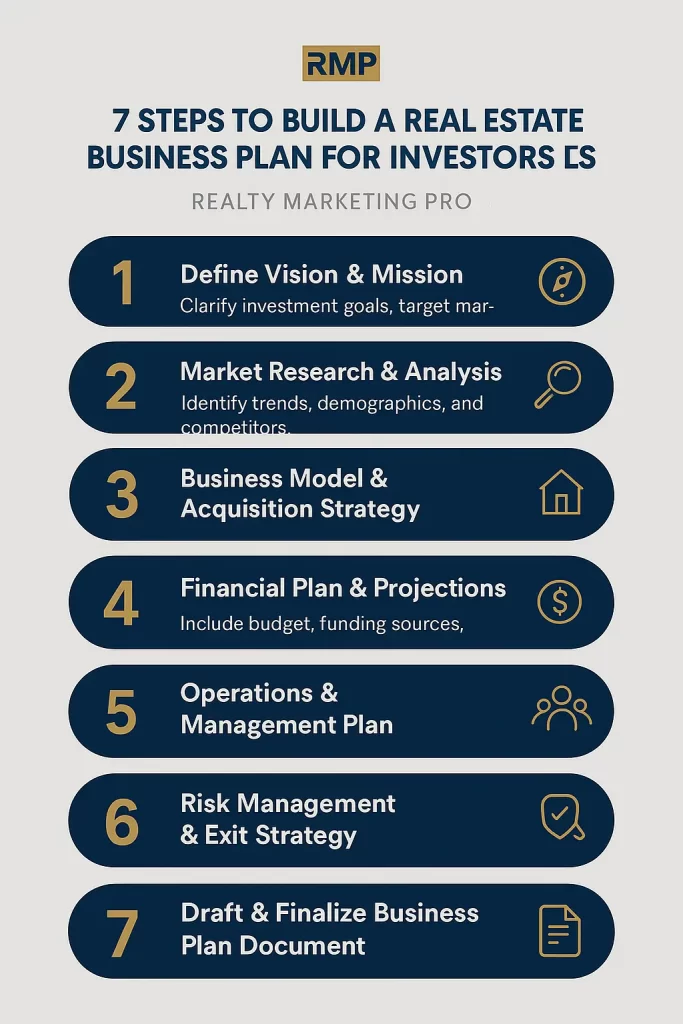
Step 1 – Define Your Real Estate Investment Vision & Mission
Establishing a clear vision and mission provides direction and purpose for every investment decision. A vision describes the long-term objective—such as building a portfolio of cash-flowing rentals or scaling into commercial assets—while the mission outlines how those goals will be achieved through strategy and operational standards.
Clarifying Long-Term Investment Goals
Long-term goals help determine the type of assets to pursue and the level of risk an investor is willing to accept. Some investors aim for steady monthly income, while others focus on appreciation or rapid capital growth through value-add projects. Stating measurable targets—such as acquiring five rental properties in three years or achieving a specific annual return—turns a general ambition into a defined pathway.
Choosing an Investment Strategy
Each investment strategy demands different timelines, capital needs, and management requirements.
- Buy and hold strategies emphasize rental income and long-term appreciation.
- Fix and flip strategies require shorter cycles and strong project management.
- BRRRR (Buy, Rehab, Rent, Refinance, Repeat) focuses on equity recycling for portfolio expansion.
- Short-term and vacation rentals prioritize occupancy rates and seasonal pricing dynamics.
Selecting a strategy early helps set realistic funding plans, acquisition criteria, and operational processes.
Establishing Your Niche and Investor Identity
A defined niche allows investors to focus on specific property types, market segments, or geographic areas. Specialization—such as workforce housing, multifamily units, or suburban single-family rentals—improves efficiency and negotiation leverage. A consistent identity helps attract aligned partners, agents, and lenders who understand the investor’s approach.
Step 2 – Conduct Market & Competitive Analysis
Accurate market analysis ensures investments align with demand, pricing trends, and economic strength. A business plan backed by data is more persuasive to partners and reduces the risk of overpaying for underperforming properties.
Evaluating Local Market Conditions
Identifying the right market requires reviewing population growth, employment trends, rental demand, and property appreciation. Metrics such as average rent, vacancy rates, and cap rates reveal the income potential and stability of a location. Investors should compare multiple markets before committing capital, especially when considering out-of-state opportunities.
Analyzing Neighborhood-Level Indicators
Micro-market dynamics can influence long-term profitability. School ratings, nearby infrastructure, redevelopment plans, and retail access affect tenant demand and property value. A neighborhood with projected economic development provides stronger appreciation potential than stagnant areas.
Studying Competitors and Investor Activity
Understanding local investor activity helps clarify what strategies are working in that market. Observing rental pricing, renovation standards, and listing inventory provides insights into market saturation. Competitor analysis also highlights potential gaps—for example, underserved property types or tenant demographics.
Using Data Tools for Market Validation
Real estate platforms such as MLS, CoStar, PropStream, Zillow, and Redfin support data-driven decisions. These tools assist in estimating after-repair values, rental comps, and purchase trends. Including market data in a business plan strengthens credibility with capital sources and justifies projected returns.
Step 3 – Define Your Business Model & Acquisition Strategy
A defined business model outlines how income will be generated, properties will be acquired, and returns will be protected. Investors who structure clear criteria avoid speculative decisions and maintain financial discipline.
Establishing Investment Criteria
Criteria act as filters for evaluating deals. Typical benchmarks include price range, property type, minimum cap rate, and renovation budget. For example, an investor might target single-family homes under $300,000 with a minimum 8% cash-on-cash return. Consistent criteria prevent emotional purchases and streamline underwriting.
Sourcing Properties and Deal Flow
Deal flow depends on reliable sourcing channels.
- MLS listings offer visibility but face competition.
- Off-market deals from wholesalers, direct-to-seller campaigns, and auctions provide better margins but require active outreach.
- Networking with agents and investors leads to private opportunities not publicly listed.
Including sourcing strategies in the business plan demonstrates readiness to compete in tight markets.
Defining Exit and Profit Strategies
Each investment requires a clear exit plan to protect returns. Some assets are held indefinitely for cash flow, while others are repositioned and refinanced through a BRRRR strategy. Flips rely on rapid resale, and syndications may include planned exits with pref returns. Outlining exit scenarios shows how and when profits will be realized.
Step 4 – Build Your Financial Plan & Projections
A financial plan demonstrates how an investment business will generate profit, manage expenses, and sustain growth. Investors who document their financial structure gain clarity on cash requirements, funding options, and long-term return potential. A strong financial section is often required when presenting a plan to lenders or private partners.
Calculating Initial Capital and Funding Requirements
Determine how much capital is needed for acquisition, closing costs, renovation, reserves, and holding expenses. Investors using leverage must outline their equity contribution and financing sources. Whether the plan relies on conventional mortgages, hard money loans, private investors, or joint ventures, clarity on funding structure is essential for credibility.
Projecting Cash Flow and Returns
Accurate projections help evaluate whether a property supports long-term goals. Estimations typically include gross rental income, operating expenses, debt service, and net operating income (NOI). Key return metrics should be included:
- Cash-on-cash return for annual profit relative to invested capital
- Cap rate to assess property performance in comparison to market benchmarks
- Internal Rate of Return (IRR) for long-term portfolio planning
Financial projections must be conservative to account for unexpected vacancies or maintenance.
Budgeting for Ongoing Costs
A business plan should list recurring expenses such as property taxes, insurance, property management fees, maintenance, and utilities. Setting aside reserve funds—for repairs and vacancy periods—prevents liquidity shortages. Detailed budgeting signals financial responsibility to lenders and partners.
Scenario Planning and Risk Adjustment
Including best-case, base-case, and worst-case scenarios demonstrates awareness of financial risk. A planned range of outcomes prepares investors to adjust strategies rather than react impulsively during economic shifts or market downturns.
Recommended: How to Conduct a Brand Audit for Your Real Estate Business
Step 5 – Create an Operational & Management Plan
Operations define how the investment business will function on a daily basis. An operational plan outlines who will manage properties, how tenants will be screened, and what standards will guide maintenance and performance tracking.
Defining Roles and Key Partners
Even solo investors rely on a broader team for efficient operations. The plan should identify essential contributors:
- Real estate agent or broker for acquisitions
- Contractor or construction crew for renovations
- Property manager or leasing agent for tenant oversight
- Accountant or CPA for bookkeeping and tax planning
- Attorney for contracts and legal compliance
Clearly stating each role ensures accountability and smooth coordination.
Property Management Structure
A decision between self-management and third-party management affects workflow, cost, and scalability.
- Self-management allows full control but requires time for tenant communication, repairs, and rent collection.
- Professional management adds cost but supports scaling, compliance, and standardized reporting.
The plan should specify how tenant issues, lease enforcement, and vacancies will be handled to maintain property performance.
Establishing Systems and Processes
Operational systems ensure consistency and protect profitability. Examples include:
- Standard tenant screening criteria using credit, income, and rental history
- Maintenance protocols for emergency and routine repairs
- Lease documentation, rent collection procedures, and accounting systems
Using property management software or reporting tools strengthens organization and transparency.
Performance Tracking and Reporting
Tracking key performance indicators (KPIs) maintains portfolio health. Metrics such as occupancy rate, rental yields, expense ratios, and repair timelines help identify inefficiencies. Transparent reporting is vital when working with partners or investors who expect measurable results.
Step 6 – Risk Management & Exit Planning
Risk management ensures the investment business can withstand fluctuations in market conditions, unexpected expenses, or operational setbacks. Investors who plan for risk protect profitability and maintain control during economic uncertainty. A sound business plan outlines both anticipated risks and specific strategies to address them.
Identifying Key Investment Risks
Real estate investments face multiple risk categories, each affecting returns differently.
- Market risk: Changes in housing demand, interest rates, or economic cycles
- Operational risk: Tenant issues, maintenance failures, or property damage
- Financial risk: Inaccurate projections, loan defaults, or rising financing costs
Recognizing these categories allows investors to allocate resources and establish protective measures.
Building Risk Mitigation Strategies
Mitigation begins with conservative underwriting, adequate cash reserves, and insurance coverage. Keeping liquidity for vacancy periods and unexpected repairs prevents forced sales. Diversifying across property types or markets reduces reliance on a single income source. Reliable contractors, vetted tenants, and structured leases further strengthen operational stability.
Planning Exit Strategies
Exit strategies define how and when returns will be captured. Each investment must include a planned outcome based on asset performance and market timing.
- Sell: Liquidate for profit after property stabilization or market uptrend
- Refinance: Extract equity through refinancing to reinvest without selling
- 1031 Exchange: Defer capital gains taxes by reinvesting into another property
- Syndication exit: Provide investors with a defined distribution and return timeline
Documenting exit options reassures stakeholders and guides portfolio decisions as markets evolve.
Step 7 – Drafting & Structuring the Business Plan Document
The formal written business plan must present information clearly, logically, and professionally. A structured format helps investors communicate strategy to partners, lenders, and private equity sources. The document should combine strategic vision with factual data and realistic projections.
Core Sections of a Real Estate Investor Business Plan
A complete plan typically includes the following components:
Executive Summary
Provides a concise overview of investment objectives, target markets, and financial goals. It should highlight the stated mission and the value proposition for stakeholders.
Company Overview
Explains the investment entity, legal structure (LLC, partnership, corporation), and ownership roles. This section defines business identity and operational scope.
Market Analysis
Summarizes regional trends, target neighborhoods, demand drivers, and competitor landscape. Data-backed market context supports investment logic.
Investment Strategy and Acquisition Plan
Details property types, sourcing channels, renovation approach, and profitability expectations. This section also defines deal criteria and metrics for selection.
Financial Plan and Projections
Presents revenue expectations, funding sources, operating expenses, and return metrics. Including three- to five-year forecasts demonstrates long-term planning.
Operations and Management Plan
Outlines roles, service providers, property management, and procedures for tenant relations, maintenance, and compliance.
Presentation Tips for Investor and Lender Readiness
A business plan should appear concise, well-formatted, and backed by relevant data. Visuals such as rental comp tables, amortization schedules, or sample deal analyses can clarify key points. Supporting documents may include pro forma spreadsheets, sample leases, or proof of financing capacity. Professional presentation reinforces credibility and positions the investor as a reliable business partner.
You Should Also Read: Digital Marketing for Real Estate Professionals
Common Mistakes to Avoid in a Real Estate Investor Business Plan
Even well-intentioned investors can weaken their strategy through incomplete or overly optimistic planning. Avoiding common mistakes ensures a stronger foundation and better reception from capital sources.
Overestimating Income and Underestimating Expenses
Inflated projections lead to misaligned expectations and financial shortfalls. Conservative estimates that reflect realistic vacancy rates and maintenance costs build credibility and protect against unexpected losses.
Ignoring Market Data and Comparable Analysis
Relying solely on assumptions without market validation exposes investors to inaccurate purchase decisions. A strong business plan must reference rental comps, demographic trends, and employment data relevant to the investment area.
Lack of Defined Exit Strategy
Failing to specify how and when an investment will be exited creates uncertainty for partners and lenders. A clear exit plan—sale, refinance, or exchange—demonstrates foresight and financial discipline.
Omitting Risk Management Measures
Business plans that overlook potential setbacks appear unprepared. Including contingency funds, insurance strategy, and backup plans for vacancies strengthens the plan’s reliability.
Conclusion
A real estate business plan for investors is more than just a document—it is a structured framework for building a profitable and resilient investment portfolio. By defining goals, analyzing markets, outlining acquisition criteria, and preparing financial projections, investors position themselves for sustainable growth and funding opportunities.
Investors who commit their strategy to paper gain clarity, attract credible partners, and make disciplined decisions across each property cycle. With proper tools, risk planning, and operational systems, a business plan becomes a living guide that evolves as the portfolio expands. Establishing this foundation sets the stage for long-term success in any real estate market.