How to Build a Real Estate Marketing Plan [Free Generator Included]
Many real estate agents rely on scattered tactics—posting on social media, sending emails, running ads—without a structured plan guiding their efforts. A marketing plan transforms those individual actions into a coordinated strategy that attracts qualified leads and strengthens brand visibility. It defines who you serve, how you communicate, and which channels deliver the highest return.
This guide explains how to build a real estate marketing plan step by step and includes access to a free Real Estate Marketing Plan Generator. The tool creates a customized strategy with Quick Wins, Long-Term Bets, and a 90-Day Action Plan tailored to your goals.
Whether you are an independent agent, part of a brokerage, or growing a team, a clear plan increases consistency, accountability, and lead generation outcomes.
What Is a Real Estate Marketing Plan?
A real estate marketing plan is a documented framework that outlines how an agent or brokerage will attract, convert, and retain clients. It defines target audiences, marketing channels, messaging, budget allocation, and timelines for execution. Rather than acting on impulse, the plan acts as a roadmap for business growth.
Agents who operate without a defined plan often face unpredictable results. They may post content regularly but struggle to convert views into appointments. A structured marketing plan solves this by aligning every activity with a defined objective—whether that objective is securing more listings, building a local brand, or generating investor leads.
A well-designed real estate marketing plan delivers three core advantages:
- Consistency – Establishes a repeatable approach to outreach, follow-up, and brand presentation.
- Efficiency – Eliminates guesswork by prioritizing high-impact actions over unplanned efforts.
- Scalability – Creates a foundation that supports future expansion through referrals, advertising, or partnerships.
Unlike general marketing plans, real estate strategies must adapt to hyperlocal markets, MLS regulations, and seasonal demand. They often integrate online channels such as property portals, Google Business Profile, and email campaigns with offline tactics like open houses and community events. A documented plan ensures these efforts work together to build authority, trust, and client engagement.
Before You Build: Key Inputs for Your Real Estate Marketing Plan

A marketing plan delivers better results when it’s based on clear inputs rather than assumptions. Defining these elements first ensures that every tactic—whether digital or offline—aligns with business objectives.
Identify Your Target Audience and Niche
Real estate markets vary significantly by location, property type, and client profile. An agent serving first-time buyers has different messaging, platforms, and lead cycles compared to one targeting luxury sellers or multifamily investors. Define who you serve by considering:
- Property focus: residential, commercial, luxury, new developments
- Client segment: buyers, sellers, investors, relocators, downsizers
- Local territory: city neighborhoods, suburbs, rural communities
A defined niche improves content relevance and helps position your brand as a trusted specialist rather than a generalist.
Set Measurable Business Goals
A marketing plan must support defined outcomes. Goals provide direction and determine how success will be measured. Rather than vague objectives, use quantifiable targets such as:
- Generate 20 new buyer leads per month
- Secure four listing appointments per quarter
- Increase website traffic by 30% within six months
Clear goals influence channel selection, budgeting, and messaging. Lead generation targets may require campaigns, while brand visibility goals may focus on community engagement and long-form content.
Allocate Budget and Resources
Resource planning prevents underperformance caused by overstretched capacity. Consider available funds for advertising, content creation, and software tools such as CRM platforms or email automation systems. Solo agents may rely on manual workflows, while teams may assign responsibilities across marketing coordinators, copywriters, and digital specialists.
A defined resource plan ensures that the marketing strategy remains realistic and executable.
Free Real Estate Marketing Plan Generator
A structured plan becomes more effective when tailored to specific goals and market conditions. Our Real Estate Marketing Plan Generator provides a customized blueprint rather than a generic template, helping agents move directly from planning to action.
What the Generator Delivers
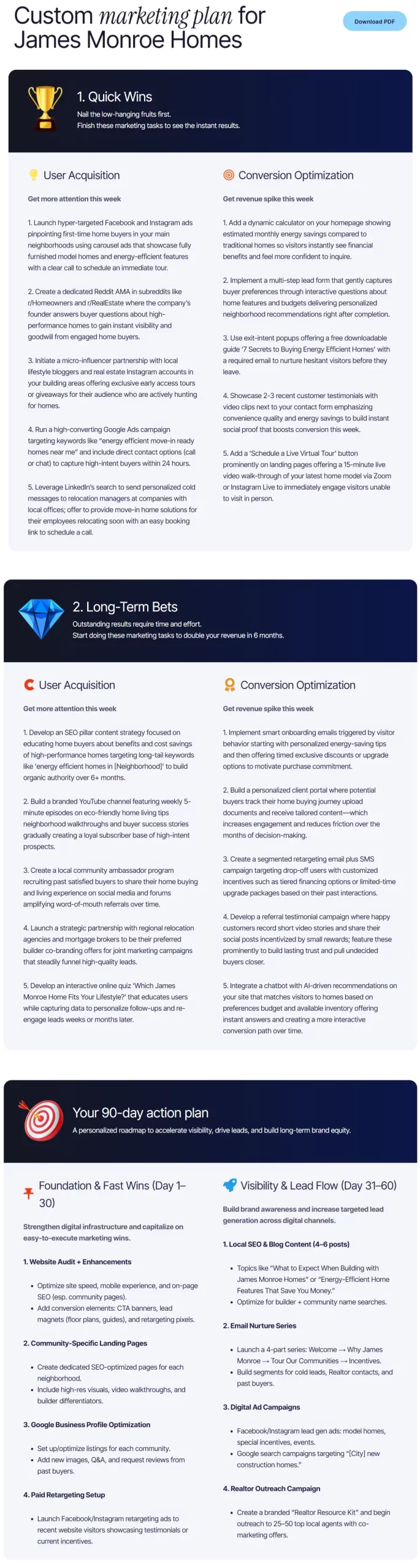
The generator produces a detailed strategy organized into key components designed to support both immediate traction and long-term growth.
Quick Wins
Quick Wins prioritize fast-moving tactics that can generate qualified leads or improve visibility without extensive setup. Depending on user inputs, this section may include:
- Lead magnet suggestions for buyers or sellers
- Social media posting frameworks with engagement hooks
- Website or landing page improvements focused on conversions
- Initial email outreach or nurture campaign ideas
These actions are designed to create early momentum and measurable progress within weeks.
Long-Term Bets
Long-Term Bets anchor the strategy with initiatives that compound over time. These recommendations focus on sustainable growth, brand authority, and market positioning. Common elements include:
- Search engine optimization for local keywords
- Content plans for neighborhood guides, property insights, or video tours
- Brand differentiation through storytelling, testimonials, and partnerships
- Referral systems through past clients and community relationships
These initiatives expand reach and credibility, ensuring stability even during market fluctuations.
90-Day Action Plan
The 90-Day Action Plan converts strategy into a practical timeline. Structured week by week, it provides clear execution steps across three months:
- Weeks 1–2: Establish core assets such as website optimization, lead offers, and CRM configuration
- Weeks 3–4: Launch outreach through email, social channels, or open house promotions
- Weeks 5–8: Deploy advertising campaigns, publish content, and test messaging
- Weeks 9–12: Analyze performance, refine high-performing tactics, and scale efforts
This roadmap enables agents to maintain consistency without guesswork, closing the gap between intent and implementation.
How to Access and Use the Generator
The generator works through guided prompts, collecting details about target audience, goals, and preferred marketing channels. Based on responses, it produces a plan formatted for real-world execution. Agents can download or adjust the output as their business evolves.
Including this tool within the planning process eliminates uncertainty and saves time otherwise spent drafting plans manually. A custom-built strategy supports confident decision-making from day one.
How to Build a Real Estate Marketing Plan (Manual Walkthrough)
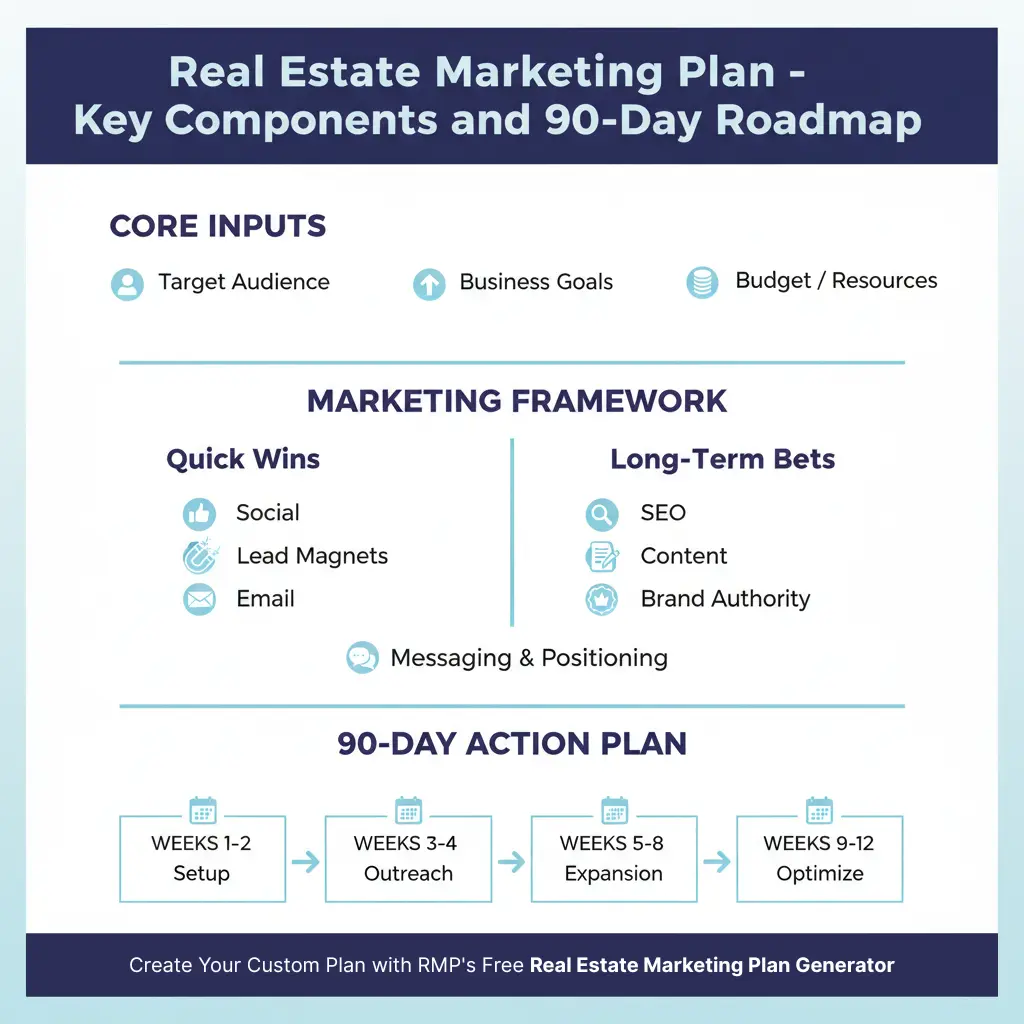
Even with access to automated tools, understanding the manual framework behind a real estate marketing plan strengthens execution. These foundational components mirror the structure used in professional strategy development and align with the outcomes delivered by the generator.
Establish Clear Positioning and Brand Identity
Clients choose agents not only for services but for clarity of value. Positioning defines what differentiates one professional or brokerage from another. This involves precise messaging, consistent visuals, and a brand voice suited to the target audience.
A luxury specialist may highlight premium service and confidentiality, while an agent targeting first-time buyers may focus on education, affordability guidance, and accessibility. Strong positioning reinforces trust and ensures marketing materials communicate a unified identity.
Develop Messaging and Content Themes
Once positioning is defined, messaging must translate into clear communication themes. Content should reflect the needs, questions, and motivations of the target audience. For example:
- Buyers often seek financing guidance, neighborhood insights, and market timing information.
- Sellers expect competitive pricing strategies, staging recommendations, and exposure tactics.
- Investors look for return potential, rental markets, and acquisition timelines.
Define recurring content pillars such as market updates, property showcases, local expertise, and client success stories to maintain relevance across platforms.
Quick Wins: Immediate Actions for Fast Results
Quick Wins generate momentum by targeting channels known for rapid visibility. These tactics require minimal setup yet deliver measurable responses when executed consistently.
Social media profiles can be optimized with professional bios, location tags, and service highlights. Lead magnets such as home valuation tools or neighborhood reports can be promoted through landing pages and email capture forms. Short-form video content showcasing listings, client tips, or local highlights increases engagement on platforms like Instagram Reels and TikTok.
These actions do not replace long-term strategy but support early traction while foundational elements are being built.
Long-Term Bets: Sustainable Growth Strategies
Long-Term Bets focus on assets that compound over time. These initiatives demand consistency but produce durable advantages, including organic traffic, recurring referrals, and brand authority.
Search engine optimization remains central to long-term growth. Optimizing website pages for terms such as “homes for sale in [city]” or “real estate agent near me” helps capture high-intent users. Content marketing using blogs, neighborhood guides, and video walkthroughs positions the agent as a market authority.
Offline strategies still contribute, particularly through community involvement, local sponsorships, or long-standing referral relationships. These efforts take time to mature but create a defensive moat around the brand.
Build the 90-Day Action Plan
A marketing plan gains value when paired with a timeline. A 90-day structure divides strategic intent into actionable stages and prevents stagnation.
Weeks 1–2 focus on infrastructure: finalize branding assets, establish lead capture systems, configure CRM workflows, and optimize websites for mobile and speed.
Weeks 3–4 introduce outreach through social media posting, email newsletters, and local networking.
Weeks 5–8 expand visibility with paid ads, property campaigns, open house promotions, or event participation.
Weeks 9–12 involve assessment: measure lead quality, refine messaging, shift budget towards high-performing channels, and eliminate underperforming efforts.
A defined timeline ensures accountability and supports gradual scaling without overwhelming resources.
Performance Tracking and Optimization
No marketing plan remains static. Tracking performance verifies whether tactics align with defined goals. Essential metrics include lead volume, cost per lead, website traffic, social engagement, and listing appointment conversion rates.
Adjustments should follow evidence, not instinct. If Instagram content drives stronger engagement than paid search, resources can be reallocated accordingly. Optimization preserves momentum and protects return on investment, ensuring that the marketing plan evolves alongside market changes and consumer behavior.
Most Common Mistakes to Avoid
A real estate marketing plan loses effectiveness when strategy is replaced by routine activity. Several recurring mistakes prevent agents from gaining consistent results, even when effort is high.
Operating Without Defined Objectives
Many agents publish content or run ads without tying actions to measurable goals. Without lead targets or listing objectives, it becomes difficult to judge performance or adjust tactics. A plan anchored in metrics—such as leads per month or listing appointments per quarter—ensures every effort serves a purpose.
Relying on a Single Marketing Channel
Dependence on one platform, such as Instagram or referrals, creates vulnerability. Market changes or algorithm shifts can reduce lead flow overnight. A balanced mix of channels—social media, search visibility, email nurturing, and local networking—provides resilience.
Inconsistent Follow-Up
Marketing generates attention, but conversion depends on follow-up. Many leads disengage when they receive delayed or generic responses. CRM automation and structured email sequences maintain engagement and improve appointment rates.
Ignoring Long-Term Brand Development
Short-term promotions may drive quick interest, but brand equity secures lifetime clients. Agents focused only on immediate wins often overlook content assets, community presence, and search visibility. These elements compound over time and increase referral volume.
Failing to Review and Optimize
A static plan cannot account for changing market dynamics. Without performance reviews, ineffective tactics remain in rotation and resources are wasted. Regular analysis—monthly or quarterly—ensures the plan evolves based on results, not habit.
You May Also Like: Real Estate Marketing Plan for Sellers
Transform Strategy Into Execution
A well-built real estate marketing plan is more than a calendar of posts or promotional ideas. It is a structured approach to growth, grounded in positioning, consistent messaging, and defined goals. When supported by both Quick Wins and Long-Term Bets, marketing becomes a predictable process rather than trial and error.
To simplify implementation, the Free Real Estate Marketing Plan Generator delivers a personalized blueprint with a 90-day roadmap, ready for immediate use. It eliminates uncertainty and replaces guesswork with clarity and action.Build your customized plan and start executing with confidence.Generate your Real Estate Marketing Plan now and convert strategy into results.