
How to Do a Comparative Market Analysis in Real Estate

Accurately pricing a property is one of the most critical skills in real estate. Whether preparing to list a home, evaluate an investment, or advise a client, understanding how to do a comparative market analysis (CMA) allows professionals to estimate a property’s fair market value using real-world data. A CMA compares similar homes—known as “comps”—that have recently sold, are currently listed, or were withdrawn from the market to identify pricing patterns and determine a realistic price range.
Real estate agents, investors, and brokers rely on CMAs to make informed decisions backed by data rather than intuition. According to the National Association of Realtors (NAR), properties priced accurately from the start sell 32% faster and with fewer price reductions. A thorough CMA helps agents demonstrate expertise, improve client trust, and support stronger negotiation strategies.
Here we will explain what a CMA is, how it differs from an appraisal, and the practical steps needed to perform one effectively.
What Is a Comparative Market Analysis (CMA) in Real Estate?
A Comparative Market Analysis (CMA) is an in-depth evaluation of a property’s value based on the sales prices of similar homes within a defined area. Real estate professionals use it to determine what a buyer might reasonably pay or what a seller should expect to receive under current market conditions.
Unlike automated valuation tools such as Zillow’s Zestimate or Redfin Estimate, a CMA incorporates local expertise, property condition, and recent market behavior—factors algorithms often overlook.
Purpose of a CMA
The main objective of a CMA is to determine fair market value—the price a property is likely to sell for in the current market. Agents typically perform a CMA:
- Before listing a home for sale.
- When advising buyers on making an offer.
- For investors analyzing purchase opportunities.
- To help property owners track appreciation or evaluate refinancing potential.
An accurate CMA ensures pricing aligns with comparable homes, reducing time on market and preventing overpricing, which can lead to stagnant listings.
CMA vs. Appraisal: Key Differences
Although both a CMA and an appraisal estimate property value, they serve distinct purposes and are performed by different professionals.
| Feature | Comparative Market Analysis (CMA) | Appraisal |
| Conducted by | Licensed real estate agent or broker | Certified appraiser |
| Purpose | Estimate market value for pricing and marketing | Determine value for financing and legal documentation |
| Cost | Usually free or included in service | Typically $300–$600 |
| Data Source | MLS data, recent sales, and active listings | Property inspection, sales records, and valuation models |
| Authority | Informal market estimate | Legally recognized valuation |
A CMA is used primarily for pricing strategy and negotiation, while an appraisal is required by lenders to confirm a property’s value before approving a mortgage.
Benefits of Conducting a CMA
Performing a CMA provides multiple advantages for both agents and clients:
- Accurate Pricing – Properties priced within 3–5% of their market value attract more qualified buyers and sell faster.
- Client Confidence – Data-driven pricing builds trust and reduces disagreements about listing price.
- Better Marketing Strategy – A clear price range allows agents to position the home competitively in online listings and advertising.
- Negotiation Leverage – Sellers can justify their asking price, while buyers gain a stronger position when making offers.
- Market Awareness – Regular CMAs help agents stay informed about local trends, seasonal shifts, and neighborhood performance.
When to Conduct a CMA
A CMA is not a one-time task. Agents often perform it:
- Before listing a home to set the initial price.
- During a listing period if a property has been on the market longer than expected.
- For buyers who need to confirm whether a property is fairly priced.
- For investors evaluating potential acquisitions or rental adjustments.
Performing CMAs consistently helps real estate professionals adapt to shifting market conditions and maintain accurate valuations over time.
Read Also: How to Get Real Estate Listings as a New Agent
How to Do a Comparative Market Analysis (CMA): Step-by-Step Guide
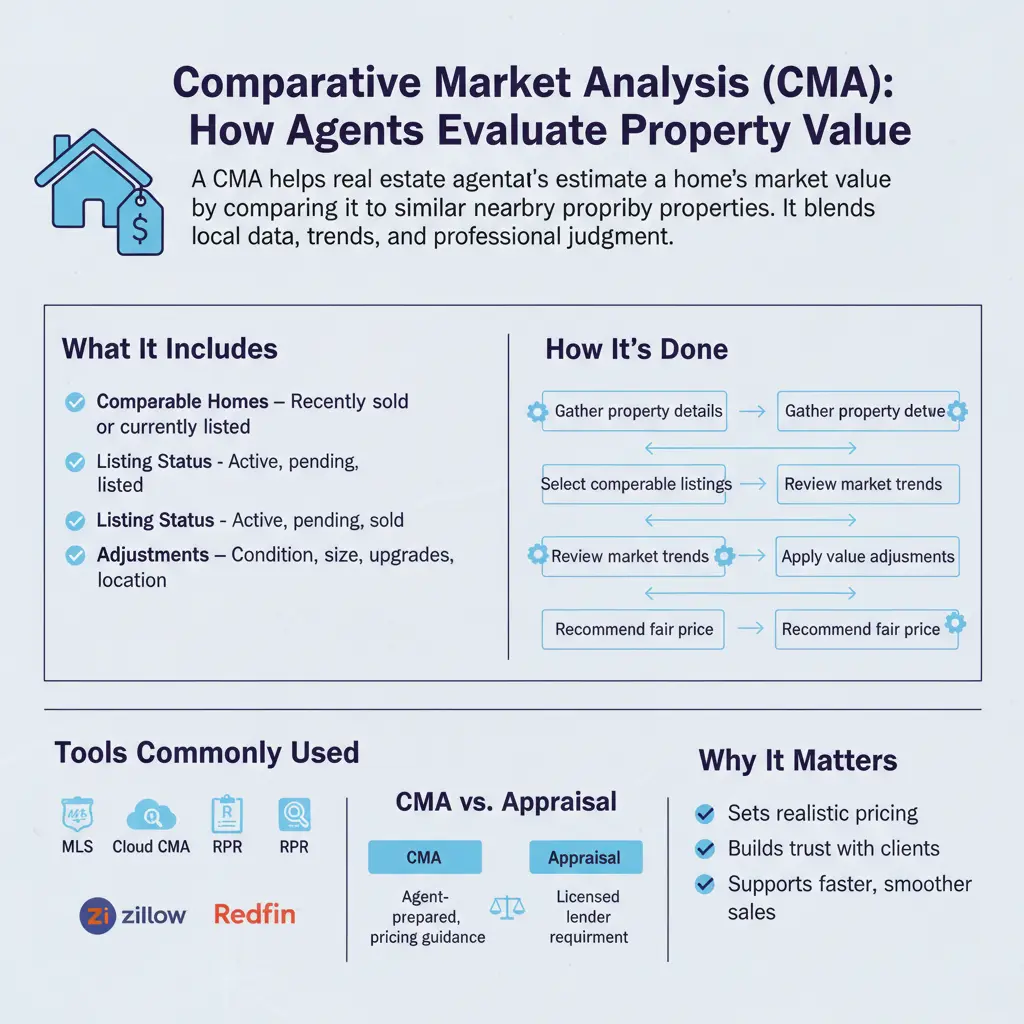
Performing a Comparative Market Analysis involves more than checking recent sales. It requires collecting property data, analyzing market trends, and applying logical adjustments to reach a fair value range. The process helps agents, investors, and homeowners make data-driven pricing decisions that reflect true market conditions.
Below is a structured, step-by-step breakdown of how to conduct a professional CMA.
Step 1: Gather Property Information
The first step is to collect every relevant detail about the subject property. A CMA is only as accurate as the information it’s built on.
Key property details include:
- Street address and neighborhood
- Property type (single-family, townhouse, condo, duplex, etc.)
- Square footage of the home and lot
- Number of bedrooms and bathrooms
- Year built and renovation history
- Architectural style, layout, and amenities (garage, pool, outdoor space, etc.)
- Condition and upgrades (new roof, remodeled kitchen, HVAC system, flooring)
Agents typically obtain this data from the Multiple Listing Service (MLS), county tax records, or prior listing information.
Note any features that could increase or decrease value compared to other homes—such as corner lots, lake views, or outdated interiors.
Step 2: Define the Market Area
A CMA must compare homes within the same local market because property values vary widely between neighborhoods, even within the same city.
To define your market area:
- Focus on homes within a 0.5–1 mile radius of the subject property in urban areas (or up to 5 miles in rural zones).
- Consider school districts, proximity to amenities, and local zoning restrictions.
- Exclude neighborhoods with different characteristics or buyer demographics.
Tools like Google Maps, MLS mapping features, and Realtor Property Resource (RPR) can help define the right geographic boundaries.
Understanding micro-markets—specific pockets within a city—ensures your comparisons truly reflect what buyers would consider “similar” in location and lifestyle.
Step 3: Identify Comparable Properties (“Comps”)
Once the market area is set, the next step is to identify comparable properties or “comps.” These are similar homes that have recently sold, are currently on the market, or were listed but didn’t sell.
Ideal comps share the following attributes:
- Similar property type and layout
- Comparable size (within ±10–15% of the subject’s square footage)
- Built within a close time range (±5–10 years)
- Located in the same or adjacent neighborhood
- Have similar condition and level of updates
Select at least three to five comps—preferably recent sales within the last 3–6 months—to reflect the current market environment.
Tips for Selecting the Right Comps
- Prioritize recently sold listings because they show actual buyer behavior.
- Include active and pending listings to understand current pricing competition.
- Review expired or withdrawn listings to spot overpricing patterns.
- Avoid comparing properties with unusual features (large acreage, luxury finishes) unless the subject property has them as well.
A well-chosen set of comps creates a realistic value baseline and helps detect pricing anomalies caused by market fluctuations or property-specific traits.
Step 4: Analyze Comparable Sales Data
After gathering the comps, analyze how they compare to the subject property in measurable terms. This is where pricing adjustments are made to normalize differences.
Key data points to evaluate:
- Sale price and list price – Reveals the ratio between asking and actual value.
- Days on market (DOM) – Indicates demand levels and pricing accuracy.
- Price per square foot – Helps compare properties of different sizes.
- Sale date – Reflects how recent and relevant the transaction is.
Agents often create a comparison table to visualize differences clearly.
| Comparable | Sale Price | Size (sq. ft.) | $/sq. ft. | Adjustments | Adjusted Value |
| Comp 1 | $420,000 | 2,000 | $210 | +$10,000 (upgrades) | $430,000 |
| Comp 2 | $410,000 | 1,950 | $210 | -$5,000 (older roof) | $405,000 |
| Comp 3 | $440,000 | 2,100 | $209 | — | $440,000 |
After adjustments, take the average adjusted price per square foot to estimate the subject property’s likely market value.
How to Make Adjustments
Adjustments quantify how certain features affect value.
- Add value for superior features (e.g., newer roof, larger lot).
- Subtract value for deficiencies (e.g., outdated kitchen, smaller size).
- Use market-based reasoning for each change. For example, if homes with renovated kitchens in the same area sell for $15,000 more, apply a similar adjustment.
These changes should always be data-backed, not arbitrary estimates.
Step 5: Estimate the Subject Property’s Market Value
With adjusted data in place, calculate the property’s estimated value range.
Formula:
Adjusted price per sq. ft. × Subject property’s sq. ft. = Estimated market value
Provide both a low-end and high-end range to account for minor market fluctuations. For instance, if comps range between $405,000 and $440,000, you might recommend a listing price of $420,000–$430,000.
This value should feel realistic to both the market and the client, ensuring the home attracts competitive offers without sitting unsold.
Step 6: Compile and Present the CMA Report
Once the analysis is complete, present the findings in a clear, professional format.
A CMA report typically includes:
- Subject property overview and photos
- Comparable property data (sold, active, expired)
- Adjustments and calculated price range
- Market overview and neighborhood stats
- Visual charts or graphs for clarity
Many agents use Cloud CMA, kvCORE, BrokerMetrics, or RPR to generate visually appealing reports. These platforms allow for customization, easy data imports, and interactive visuals that enhance client presentations.
Pro Tips for Presenting a CMA to Clients
- Use charts or graphs to illustrate market trends.
- Explain pricing logic in simple, transparent terms.
- Address emotional pricing expectations tactfully by showing real data.
- Connect the results to the marketing strategy—for example, why pricing 2% below competitors can attract more showings in the first week.
A well-presented CMA not only justifies pricing but also reinforces the agent’s market expertise.
Step 7: Review and Update Regularly
Real estate markets shift rapidly. Review and update your CMA every 30–60 days or when major events affect local pricing—such as new developments, interest rate changes, or zoning adjustments.
Regular updates help agents refine their strategy, keep clients informed, and adjust prices proactively rather than reactively.
Tools and Resources to Create a Comparative Market Analysis
A comparative market analysis relies on accurate data. Modern real estate tools make it easier to gather property details, analyze pricing trends, and present professional reports that impress clients.
MLS (Multiple Listing Service)
The MLS remains the foundation of any CMA. It provides comprehensive data on active, pending, and recently sold properties, including listing history, property size, and days on market. Agents can filter properties by neighborhood, price range, and property type to ensure accurate comparisons.
Public Property Records and County Assessor Websites
County assessor databases offer verified information on ownership history, tax assessments, and property characteristics. This data helps confirm details not always available in MLS listings, such as renovations or property tax trends that may affect value.
Real Estate Platforms
Websites like Zillow, Redfin, and Realtor.com provide broad market visibility. While they shouldn’t replace MLS data, they’re useful for gauging buyer sentiment and neighborhood demand trends. Zillow’s Zestimate, for instance, can indicate general market movement but should always be cross-checked with verified data.
CMA and Valuation Software
Professional-grade software such as Cloud CMA, CoreLogic’s Matrix, and Top Producer CMA streamline report creation. These tools generate branded presentations that include maps, comparable listings, and value adjustments, making the CMA visually clear and client-ready.
Market Analytics Platforms
For agents working in competitive or high-value markets, tools like RPR (Realtors Property Resource) or HouseCanary offer advanced analytics, including appreciation forecasts and neighborhood demographic data. These insights can add depth to your CMA and support more informed pricing recommendations.
Expert Tips for Accurate Real Estate Market Analysis

Even with advanced tools, accuracy depends on the analyst’s judgment. These best practices help ensure that your CMA reflects true market conditions and supports reliable pricing decisions.
1. Focus on Truly Comparable Properties
Choose comparables within a 0.5 to 1-mile radius of the subject property, sold within the last three to six months. Properties outside this range may not reflect the same market conditions.
Match property type, size, and age as closely as possible — for example, a renovated 2,000-square-foot ranch shouldn’t be compared to an older two-story colonial.
2. Account for Market Shifts
Markets can change quickly due to interest rate fluctuations, new development projects, or shifts in buyer demand. Use both historical data and current active listings to understand direction — whether prices are trending upward or softening.
3. Adjust for Key Differences
When comparing, apply value adjustments for differences in features such as square footage, lot size, garage capacity, or recent renovations. For instance, a finished basement may add $10,000–$20,000 depending on local buyer preferences.
4. Verify All Data Sources
Cross-check information from MLS, public records, and seller disclosures. Incorrect square footage or missing updates can significantly distort your valuation.
5. Keep Presentation Simple and Transparent
When presenting a CMA to clients, clarity builds trust. Use clean visuals, remove jargon, and explain how each comparable influenced your recommended price range. Clients value transparency more than complexity.
How to Use a CMA to Win Listings and Build Client Trust
A well-prepared CMA is more than a pricing tool — it’s a credibility builder that positions you as a knowledgeable real estate advisor.
Use CMAs in Listing Presentations
When meeting potential sellers, use your CMA to demonstrate local market expertise. Walk them through each comparable, show why pricing too high could delay a sale, and explain the risks of underpricing.
Highlight your analytical process, not just the outcome. This reassures homeowners that your pricing recommendation is grounded in data, not opinion.
Strengthen Buyer Consultations
For buyers, a CMA helps justify offer prices. Presenting data-driven insights prevents emotional overbidding and supports informed negotiation. When a buyer sees that their offer aligns with comparable sales, they gain confidence in your guidance.
Create Ongoing Market Updates
Continue providing updated CMAs for clients after the transaction. Sending a quarterly “home value snapshot” helps maintain relationships and positions you for repeat business or referrals.
Showcase Professionalism and Objectivity
Clients respect agents who provide data-backed insights instead of vague estimates. A detailed CMA shows analytical ability, market awareness, and transparency — three traits that drive long-term trust and stronger client retention.
FAQs About Comparative Market Analysis in Real Estate
What is the main purpose of a comparative market analysis?
A comparative market analysis (CMA) helps determine a property’s fair market value by comparing it to recently sold, active, and pending listings in the same area. It guides sellers in pricing their home competitively and helps buyers make informed offers.
How do you choose comparable properties for a CMA?
Comparable properties should be as similar as possible to the subject property. Choose homes located within a 0.5–1 mile radius, sold within the last three to six months, and with similar size, condition, and features.
How accurate is a comparative market analysis?
A CMA is generally accurate when based on reliable, up-to-date data and adjusted for property differences. However, it’s not a formal appraisal — it estimates value based on market trends rather than a certified appraiser’s valuation.
What’s the difference between a CMA and an appraisal?
A CMA is created by a real estate agent to estimate listing or offer prices using recent sales data.
An appraisal is performed by a licensed appraiser for lenders and involves a more detailed valuation process following industry regulations.
How often should a CMA be updated?
In active markets, a CMA should be updated every 30 to 60 days. Price trends, new listings, or recent sales can shift property values quickly, making regular updates essential for accuracy.
Can buyers request a CMA before making an offer?
Yes. Buyers can ask their agent for a CMA to understand local pricing and make data-backed offers. This prevents overpaying and strengthens their negotiation position.
How do agents present a CMA to clients?
Agents typically include charts, comparable listings, and price range recommendations in a professional CMA report. The key is to explain how each comparable property influenced the final suggested value clearly and transparently.
Is a CMA free for clients?
Most real estate agents provide a CMA for free as part of their listing presentation or buyer consultation. It’s an effective way to demonstrate expertise and build client trust before signing an agreement.